Showing posts with label Procedures. Show all posts

Sunday, August 19, 2012

Sketches and Finished Art - Part 2


As mentioned in an earlier blog, there is much to learn by studying sketches alongside the finished work.  The decisions of the artist in refining their concepts become visible and this should lead us to better and/or different thinking as we create our own works.

A sketch by Jose Segrelles for his painting "The Rhinegold".

Detail of "The Rhinegold".  Note the figure changes of the Rhine Maidens.


Herbert Draper's "The Gates of Dawn".

Otto Greiner studies for "Ulysses and the Sirens".   (Below)


John Singer Sargent's "Lady Macbeth"
Various ideas for "The Mermaid" by Andrew Loomis
The finish by Loomis
"Perseus and Andromeda" by Lord Leighton.

Saturday, July 21, 2012

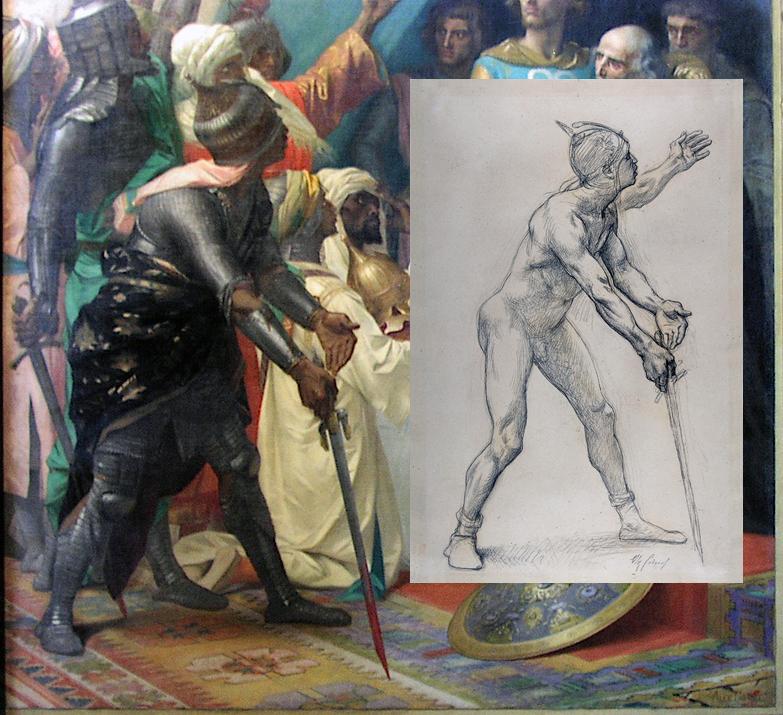
Sketches and Finished Art

I love comparing sketches to finished work. Aside from being able to gain insights into the working procedures of various artists, the more important reason is to see their thought process in pushing the picture forward. To see what they learned from doing the sketch, and needed to correct in the final painting. This could be a repositioned arm or a major change to the pose.  An adjustment of the value composition or adding completely new elements.

A Detail of a Mural by Alexander Cabanel
 When you see a difference between the sketch and finish you should try to reconstruct the artist thoughts and reasons for the change.  Always assume he had a good reason.

Campaspe by John William Godward

Of course, unless an artist is extraordinarily lucky (or skillful) there will be changes necessary between the sketch and finish. The sketch is a tool to identify what is right and what is wrong in the pre-conception of the image that the artist holds in his minds eye.


The primary difference between these Bouguereau images (below) is the development of the darker values. The darkening behind the legs at the bottom helps the "rise" of the figures. However this darkening required Bouguereau to redesign the silhouette of the white drapery to flow behind the mans foot to make it read easier and disengage it from the background thereby adding to the feeling of floating. Additionally it creates an alignment of leg, foot and cloth edge that echos and reinforces the lines of the woman's legs pointing diagonally down to the lower corner and again emphasizes the thrust upward.

A Bouguereau Finish and sketch painting.
A sketch drawing for Herbert Draper's "Flying Fish"
Another Bouguereau sketch.