Showing posts with label Symbolism. Show all posts

Thursday, August 2, 2012

19th Century Dragons

In studying 19th Century Fantasy Art I have noticed, (and made a recurrent theme of these blogs as well as my Facebook album) that many developments of the modern world have severely restricted and narrowed the imagination of more recent fantasy artists.  In the case of dragons I blame paleontology and the discovery of the "Brontosaurus". (Although scientific naming convention says that that name is no longer correct and it should be called an Apatosaurus, to me it will always be a Brontosaurus as mentioned in the 1933 King Kong.)
Two strange beasts by Rudolf Jettmar.
In these examples of Dragon paintings we see a wide variety of body form and details.


Franz Moser Dragon

Sydney Muschamp's "The Enchantress"

Surand Painting.
Another Franz Moser image.

An early painting by Alphonse Mucha.

A Sea Serpent by Elihu Vedder (Sort of a dragon).
A "Post" cover by J C Leyendecker with an odd take on a Dragon.


Monday, July 30, 2012

Alternate Flying Methods

Flying figures are a common feature in Fantasy Art. Usually this takes the form of winged people or simply figures floating magically. So while melding over Fantasy images from my Facebook gallery "Victorian Fantasy Paintings", I thought I would show alternate forms of flying.

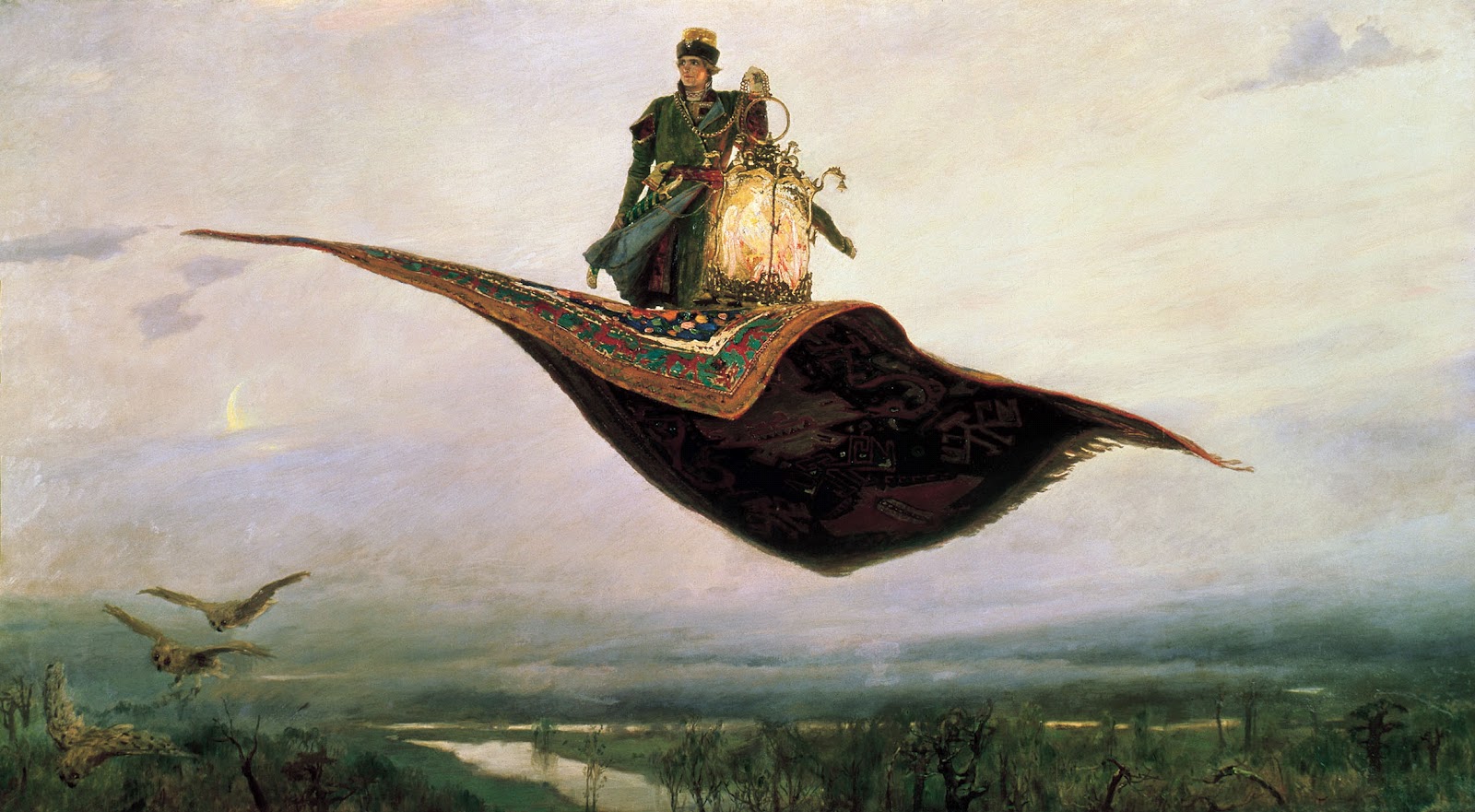
A beautiful Flying carpet painting by Vasnetsov.
Jose Segrelles paints a much more free form flying carpet.
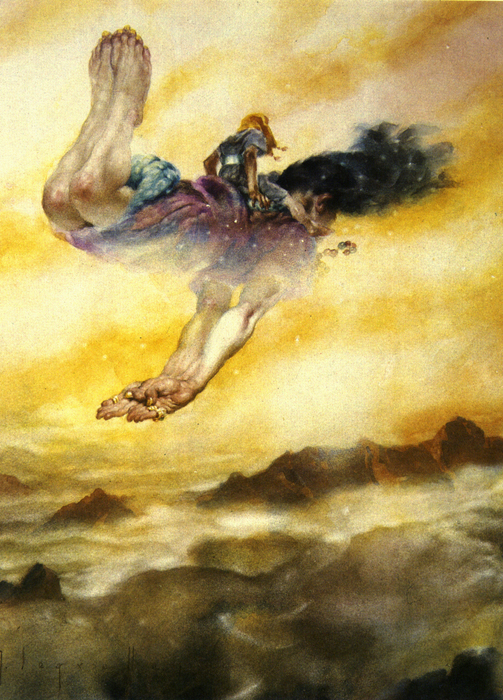
"The Flying Islands of the Night" by American illustrator Franklin Booth.

Norman Rockwell's  illustration for "The Goddess and Private Gallagher".
Edward R Hughes paints a watercolor of an anachronistic Pegasus

Willy Pogany's film advertising art of flying by Genie.
A beautifully sensitive watercolor of riding on a Genie by Segrelles
By Gustave Dore, here is a frog flying on a kite. "Between Sky and Ground".
Frantisek Kupka drawing of a Griffin mount.

Flying on the back of ?  A painting by Maximilian Pirner.
W Heath Robinson watercolor of flying on clouds.

Wednesday, July 18, 2012

Imaginative color in 19th century fantasy art - Part 1


Here are a few of the images previously posted in my “Victorian Fantasy Art” album on Facebook, but with new comments:
This is a painting by Benes Knupfer who has pushed the colors in a lyrical direction.
Before color photography began limiting the imagination of artist by “dumbing down” the color range that they were used to seeing (remember that the photographic process compresses the millions of color shades of nature into a mechanically limited few thousand) fantasy artists felt free to stretch the colors in their paintings in lyrical and dramatic directions, though always taking care to maintain a naturalistic proportional relationship among the colors.

A mysterious beauty of a painting by Maximilian Pirner who has made some unexpected color choices
This made sure that even as the colors were exaggerated the image still gave the impression of being a believably real representation. When these proportional relationships between colors and values are lost the image begins to look cartoony and the main goal of good fantasy art: “To make the unreal seem real” is lost as well.

"Pharaoh's Army Engulfed By The Red Sea" by Frederick Arthur Bridgman.
Gaston Bussiere's painting of "The Rhine Maidens"

Another Bussiere painting of sirens.  He always paints with highly saturated colors.

Tuesday, July 17, 2012

19th Century Fantasy Art


This is a continuation and expansion of the “Victorian Fantasy Painting” album that I have been posting on Facebook.  Along with new posts here, I plan to meld over the images and insights from that gallery so that all the images can be found and appreciated in one location.

My primary goal in creating these posts is to re-introduce many forgotten fantasy paintings and artists to modern day followers of that genre, whether practicing artists themselves or fans of fantasy art.  The great defect with most art history books is that they continually reprint the same “Important” paintings over and over again while ignoring the wider world of the entire movement.  As a result, most contemporary artists have a very limited view of the thought processes practiced back then in the act of creativity.  The world of fantasy art today is bound by unnecessary habits and restrictions that leave the genre all the poorer.

"The Cloud" by Arthur Hacker
The nude form has long been a staple of almost all art.  In fantasy art it has a rich place because of the various conceptual uses it can be applied to.  My favorite is “Allegory” in which the human form is used to symbolize an abstract concept or condition, or an aspect of nature.  Arthur Hacker uses it beautifully in “The Cloud”.  The human form enhances the connection of the viewer and therefore the emotional communication.

Hermann Behrens depicts a woman whose vanity (the mirror symbol) is associated with Death.
 Another use of the nude is to serve as an anchor for a philosophical statement about such concepts as the danger of the female of the species.  Symbolist art of this period is rife with allusions to death and decadence in relation to the “Femme Fatale”

"Lilith" by John Collier
Finally the nude was popular in depicting specific characters from mythology.  In fact this genre was popular because it provided an excuse (for those who needed one) to paint a beautiful nude.